What Do Mint Marks Mean on Old U.S. Coins? A Jeweler's Guide to Coin Values
What Do Mint Marks Mean on Old U.S. Coins? A Jeweler's Guide to Coin Values
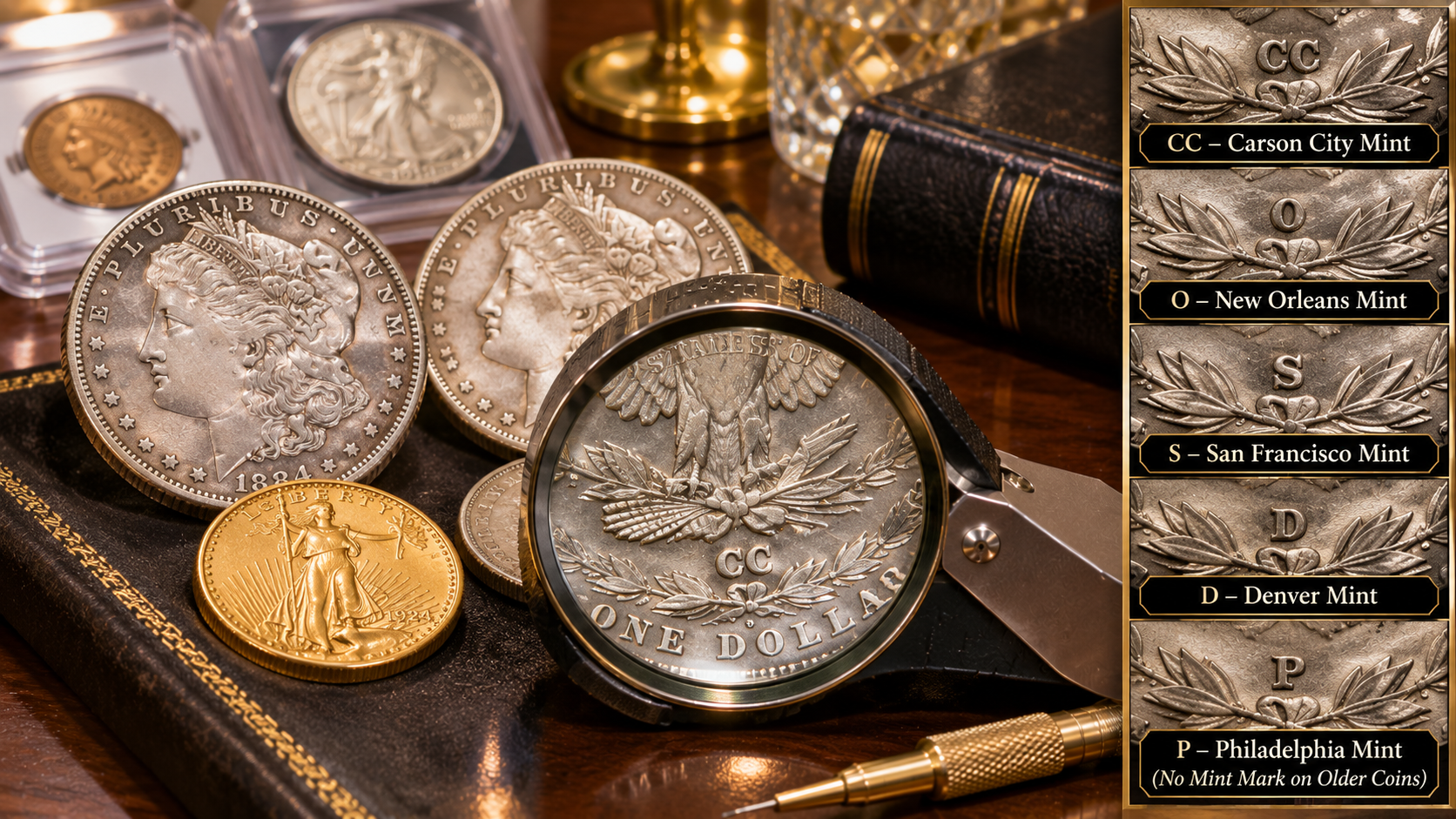
Have you ever examined an old silver dollar, quarter, dime, or gold coin and noticed a tiny letter such as P, D, S, O, CC, or W?
That small marking could tell you something important about your coin's history—and potentially its value.
These letters are known as mint marks, and they identify the United States Mint facility where a coin was produced.
If you're wondering “what does a D mean on a coin,” “what is a CC mint mark,” “are coins without mint marks valuable,” or “how do I know whether my old coins are worth money,” understanding mint marks is an important first step.
At St. Louis Gold Buyers & Jewelry Center, we help customers throughout the St. Louis area understand the precious-metal and potential collectible characteristics of eligible gold coins, silver coins, bullion, and inherited coin collections.
Before selling your old coins, here's what you should know about mint marks and why they matter.
What Is a Mint Mark on a Coin?
A mint mark is a letter or combination of letters identifying the facility where a coin was struck.
Historically, these markings helped identify which mint was responsible for producing a particular coin.
Today, mint marks also help collectors distinguish coins produced at different locations.
For example, two silver dollars may have the same date and contain the same amount of silver, but different mint marks can make one considerably scarcer than the other.
A coin's date, mint mark, condition, and collector demand can all influence its market value.
However, a mint mark alone does not automatically make a coin rare or valuable.
What Do P, D, S, O, CC, and W Mean on Coins?
The United States has operated several mint facilities throughout its history.
Each has used a particular letter or abbreviation.
Mint MarkU.S. Mint LocationGeneral PeriodPPhiladelphia, PennsylvaniaUsed on selected coins beginning in 1942DDenver, Colorado1906–presentSSan Francisco, California1854–presentONew Orleans, Louisiana1838–1861; 1879–1909CCCarson City, Nevada1870–1893WWest Point, New YorkUsed on coins beginning in the 1980sCCharlotte, North Carolina1838–1861DDahlonega, Georgia1838–1861
Notice that D has represented two different mint locations.
On certain older U.S. gold coins produced between 1838 and 1861, D refers to Dahlonega, Georgia.
On coins dated 1906 onward, D generally identifies Denver.
This distinction is one reason an item's date and denomination must be considered alongside its mint mark.
Does a Coin Without a Mint Mark Have Value?
Absolutely.
One of the most common misconceptions is that a coin without a mint mark must be rare—or that it must be counterfeit.
Neither assumption is correct.
For much of American coinage history, coins produced in Philadelphia did not carry a mint mark.
For example, many older U.S. coins without a mint mark were simply produced at the Philadelphia Mint.
Philadelphia began using the P mark on selected coins during World War II. Its use expanded in 1979 and 1980.
Even today, most ordinary Philadelphia-minted Lincoln cents do not carry a P mint mark.
An exception occurred in 2017, when Philadelphia cents featured a P to commemorate the Mint's 225th anniversary.
A missing mint mark is not automatically a valuable minting error.
The coin's date, denomination, and expected design must be checked before determining whether a marking is truly missing.
Why Don't Coins From 1965, 1966, and 1967 Have Mint Marks?
If you've examined U.S. coins from 1965, 1966, or 1967, you may have noticed that they don't have mint marks.
This was intentional.
During the 1960s, the United States experienced a coin shortage.
The U.S. Mint temporarily discontinued mint marks on circulating coins to help discourage collecting based on mint location while increasing coin production.
Mint marks returned in 1968.
Therefore, an ordinary U.S. coin dated 1965, 1966, or 1967 without a mint mark is not unusual simply because the mark is absent.
These coins should be evaluated according to their denomination, composition, condition, and any genuine collectible characteristics.
Are Carson City Coins With a CC Mint Mark Valuable?
Some are.
The Carson City Mint in Nevada operated during the nineteenth century and produced gold and silver coins.
Its CC mint mark is particularly recognizable among collectors of Morgan silver dollars.
Carson City coins are often associated with the historic American West and silver mining.
Certain Carson City issues have significant collector premiums because of their rarity, surviving population, and demand.
However, not every CC coin has the same value.
Important factors include:
- Date
- Denomination
- Original mintage
- Surviving population
- Condition
- Authenticity
- Collector demand
For example, certain Carson City Morgan dollars are much more common than others.
Do not assume every Morgan dollar marked CC is worth the same amount.
If you've inherited silver dollars carrying a CC mint mark, consider having them examined before selling strictly for their silver content.
For more information, read our guide to the Best Place to Sell Silver Coins in St. Louis.
What Does an S Mint Mark Mean on a Silver Dollar?
An S mint mark generally indicates production at the San Francisco Mint.
This mark appears on many historic U.S. silver and gold coins.
However, not all San Francisco coins are rare.
Some were produced in large quantities, while certain dates and varieties are highly collectible.
For example, the 1893-S Morgan silver dollar is a famous scarce-date issue sought by collectors.
Its desirability reflects the specific combination of date, mint mark, condition, authenticity, and surviving supply—not simply the presence of the letter S.
If you discover an older silver dollar with an S mint mark, identify the full date and coin series before estimating its value.
What Does a D Mint Mark Mean on an Old Coin?
For coins produced at the Denver Mint beginning in 1906, a D generally identifies Denver.
Denver has produced many common circulating coins, so the letter D alone does not indicate rarity.
However, certain dates are particularly desirable.
A well-known example is the 1916-D Mercury dime.
This issue has a relatively low original mintage and strong collector demand.
A genuine 1916-D Mercury dime may have substantially more numismatic value than an ordinary circulated silver dime.
Because valuable coins can be counterfeited or altered, professional authentication is especially important for rare date-and-mint-mark combinations.
Where Can I Find the Mint Mark on My Coin?
Mint marks can appear in different locations depending on the coin's denomination, year, and design.
Morgan Silver Dollars
On original Morgan silver dollars with mint marks, the letter or letters generally appear on the reverse, below the eagle and above the denomination.
Peace Silver Dollars
On original Peace silver dollars, a mint mark, when present, appears on the reverse near the lower-left area of the eagle's tail.
Lincoln Cents
The mint mark is generally located below the date on coins that carry one.
Mercury Dimes
The mint mark, when present, is located on the reverse, near the lower portion of the design.
Washington Quarters
The mint-mark location depends on the year and design. On many older examples, it appears on the reverse; on later issues it appears on the front.
Jefferson Nickels
Mint-mark placement varies by period. Silver-alloy wartime nickels made from 1942 through 1945 have a large mint mark above Monticello on the reverse.
Use a magnifying glass and appropriate lighting to examine small markings.
Avoid scratching or polishing the coin to make the letter easier to see.
Can a Mint Mark Make a Coin Worth More Than Its Melt Value?
Yes.
This is one of the most important reasons collectors pay attention to mint marks.
Many older U.S. gold and silver coins contain valuable precious metal.
Their theoretical melt value is based on the amount of pure gold or silver they contain and the current market price.
However, a particular date-and-mint-mark combination may have additional numismatic value, meaning collectors are willing to pay a premium.
For example:
- A common circulated silver dollar may be valued partly according to its silver content.
- A scarce-date Morgan silver dollar may have a substantial collector premium.
- Certain historic gold coins can be worth more than their gold content.
- A rare copper or nickel coin may have collectible value despite containing little or no precious metal.
The important distinction is between precious-metal value and collectible market value.
Read our Beginner's Guide to Gold & Silver Coins to learn more about bullion coins and collectible coins.
Are Modern Coins With W Mint Marks Valuable?
Some modern coins bearing a W mint mark can attract collector interest.
The W identifies the West Point Mint.
West Point has produced various bullion, proof, and collector coins.
In 2019, the United States Mint also released a limited number of W-marked quarters into circulation.
These became an interesting collectible category because they were produced in much smaller quantities than many ordinary circulating quarters.
However, the value of an individual W-marked coin still depends on the exact issue, condition, authenticity, and demand.
A W mint mark alone does not guarantee a particular resale price.
What's the Difference Between a Mint Mark and a Privy Mark?
A mint mark identifies the facility that produced a coin.
A privy mark is a separate symbol or marking used to commemorate an event, distinguish an issue, or convey other information.
This distinction is especially important with modern Morgan silver dollars.
For the 2021 Morgan Dollar anniversary program, the U.S. Mint produced versions with CC and O privy marks honoring Carson City and New Orleans.
Those commemorative coins were not produced at the historic Carson City or New Orleans facilities.
The CC and O privy marks recognize those former mint locations.
Therefore, when evaluating a modern coin, it's important to identify whether the marking is an actual mint mark or a commemorative privy mark.
Can Mint Marks Be Fake or Altered?
Unfortunately, yes.
Certain rare coin varieties are valuable enough that counterfeiters may attempt to add or modify mint marks.
Examples of alterations include:
- Adding a mint mark to a common coin
- Changing an existing mint mark
- Altering a coin's date
- Creating counterfeit coin surfaces
- Producing entirely counterfeit coins
A rare-looking date-and-mint-mark combination should not automatically be assumed genuine.
Professional authentication may be appropriate for valuable or unusual coins.
Our article What Are the Major Coin Grading Companies? explains how recognized grading services help establish authenticity and condition.
Should I Clean My Coins Before Having the Mint Marks Evaluated?
No.
Cleaning can permanently damage a coin's original surfaces and reduce collectible appeal.
Even if a coin appears tarnished, dark, or worn, avoid using:
- Metal polish
- Toothpaste
- Baking soda scrubs
- Abrasive cloths
- Harsh chemicals
- Wire brushes
For potentially rare coins, original surface preservation is especially important.
If the mint mark is difficult to see, use magnification rather than attempting to remove tarnish.
What Should I Do If I Inherited Coins With Unfamiliar Mint Marks?
Inherited coin collections may contain a combination of bullion coins, common silver coins, and potentially collectible pieces.
Before selling:
Keep Coins in Their Existing Holders
Original packaging and professional grading cases can provide useful protection and identification information.
Separate Coins by Type
Group silver dollars, gold coins, pre-1965 silver coins, and other identifiable categories.
Look for Date-and-Mint-Mark Combinations
Record unusual letters and dates without attempting to clean the coins.
Save Documentation
Preserve grading certificates, receipts, old collection lists, and coin albums.
Avoid Selling Everything Strictly by Weight
Potentially collectible pieces may be worth more than their precious-metal content.
Consider Specialist Evaluation
Rare coins and unusual varieties may warrant examination by a qualified numismatist.
For more guidance, visit our published article Where Can I Sell Old Coins in St. Louis?.
Where Can I Sell Old U.S. Coins in St. Louis?
If you're searching for “old coin buyers near me,” “sell Morgan silver dollars St. Louis,” “coin buyers St. Ann,” or “where can I sell old gold and silver coins,” St. Louis Gold Buyers & Jewelry Center provides free, no-obligation purchase evaluations for eligible precious-metal coins.
We evaluate and purchase eligible:
- Morgan silver dollars
- Peace silver dollars
- American Silver Eagles
- Pre-1965 U.S. silver coins
- Gold coins and bullion
- Silver bars and rounds
- Other eligible precious-metal coins and collections
Our team explains the relevant precious-metal content, market conditions, and characteristics affecting purchase offers.
If coins appear to have significant collectible value requiring specialized expertise, an additional numismatic opinion may be appropriate.
Learn more about our precious-metal purchasing services and silver-buying services.
Why Choose St. Louis Gold Buyers & Jewelry Center?
Our family-owned business has served the St. Louis metropolitan area since 2005.
At our convenient St. Ann storefront, customers benefit from:
- Free, no-obligation purchase evaluations
- Transparent precious-metal testing and weighing
- Competitive purchase offers
- Customer parking directly in front of the store
- Ground-level access without multiple floors
- Walk-in service during regular weekday business hours
- Same-day payment when an eligible purchase offer is accepted
Whether you have a few silver dollars, a collection of old gold coins, or precious-metal items inherited from a family member, we're here to help you understand your options.
Frequently Asked Questions About Coin Mint Marks
What does a P mean on a coin?
P generally identifies the Philadelphia Mint. However, many Philadelphia coins have no mint mark, depending on the year and denomination.
What does a D mean on a coin?
D generally identifies Denver on coins dated 1906 or later. On certain nineteenth-century U.S. gold coins, D identifies Dahlonega, Georgia.
What does an S mean on a coin?
S generally identifies San Francisco.
What does CC mean on a silver dollar?
On original historical U.S. coins, CC identifies the Carson City Mint in Nevada. Certain modern commemorative coins use a CC privy mark instead.
Are coins without mint marks rare?
Not automatically. Many coins were intentionally produced without mint marks, including ordinary circulating coins dated 1965 through 1967.
What does an O mean on a silver dollar?
On original Morgan silver dollars, O identifies the New Orleans Mint. Certain modern Morgan dollars use an O privy mark to commemorate that mint.
Does every coin with a W mint mark have value?
Not necessarily. Some W-marked coins have collector premiums, but value depends on the specific issue, condition, authenticity, and demand.
Can two coins from the same year have different values?
Yes. Coins with the same date may have different mint marks, production quantities, surviving populations, and collectible demand.
Should I have an unusual mint mark professionally examined?
If a coin appears scarce, valuable, altered, or unusual, professional authentication may be worthwhile.
Can I sell old silver dollars without having them graded?
Yes. Many silver dollars can be evaluated without third-party grading, although potentially rare examples may benefit from specialist authentication.
Conclusion: A Small Mint Mark Can Make a Big Difference
A tiny letter on an old coin can provide important information about where it was produced.
But mint marks are only one part of determining a coin's value.
The date, denomination, precious-metal content, condition, authenticity, rarity, and collector demand all matter.
Some coins are worth primarily their gold or silver content, while others may have additional collectible value.
Before selling old coins, take time to identify their markings and consider whether any pieces deserve specialist attention.
At St. Louis Gold Buyers & Jewelry Center, we help customers throughout the St. Louis area understand their eligible gold coins, silver coins, bullion, and precious-metal collections.
Have old coins with P, D, S, O, CC, or other mint marks? Bring them in for a free evaluation and find out what they may be worth.
St. Louis Gold Buyers & Jewelry Center
9814 St. Charles Rock Road
St. Ann, MO 63074
Phone: (314) 427-4653
Contact Our Team | Get Directions
Free Evaluations. Transparent Offers. Competitive Payouts. No Pressure to Sell.